
The Clowns
Fellini's 1970 film & the Decline of the Circus

I’ve had the fortune of re-watching Fellini’s I Clowns, a 1970 masterpiece that is both a documentary and one of the few remaining memories of a bygone era. Like other documentaries such as This is Spinal Tap & The Office, there is a seriousness to the subject matter that can’t be easily categorized, since it features new performances and not just archival reels and interviews. Many statements could be read or heard back as if they are both joking and not joking, and that is part of the dual nature of the film.
“Rémy says to me, Why are you making a film about clowns? The world of circus no longer exists. The clowns are all gone.
The circus no longer makes any sense to the real world. And it should finish like that”
I thought about this movie yesterday after watching a screen reaction video. It was on a completely different topic- datacenters and water usage. But something about the video made me wonder about this new generation’s use of reactions to elicit a like (as in similar, not thumbs up) response. I am not sure if it is a lack of self-awareness, or just a rudimentary understanding of expressions, but reaction videos strike me as wishful thinking. I tend to use reactions in real life, from an early age. But it is a currency that few people notice frequently. Sure, everyone uses their own brows, squints, and upper lips, but many reactions go unnoticed, especially if no one is looking.
One could say that the Gen Z stare mutes or Botox has something to do with it, but I think the lack of expression isn’t as bad as it appears. However, some in the conservative media remain concerned that clowns are creepy, for lack of a better category of words, or rather, the need to use one at all. Rather, I’m mildly optimistic that what appears to be a vapid stare is actually a unique adaptation to a saturated digital world in processing a large volume of environmental signals- yes, often belatedly, but in batches of of reactions. Yes, we’ve turned into robots, and have internalized a lot of its batch-like processes, but everyone is learning, even in a different way from my generation.
The setting for a circus or clown in modern times is nearly non-existent. I’m relieved the Cirque de Soleil exists, because the terminally online mind often seems quite detached from reality, despite being subject to streams of video feeds, and I think a circus would be a better and less expensive form of therapy, if someone living in an alternate universe ever decided to space travel across their hallway of pizza boxes.
“I’m afraid that in your film you say clowns no longer exist. They haven’t disappeared - it’s just that people don’t know how to laugh anymore.”
If I were to write a science fiction novel, it would be Winston in 1984 sitting in the corner of his room, with a telescreen, wearing floppy shoes and a red nose, mimicking the red light pointing at his face, because in the era of mass surveillance and artificial intelligence, cameras use machine learning to create what’s called “computer vision,” and a data collection and classification apparatus so large it would make Linnaeus and Dewey regret their contributions to knowledge.
Yes, computer vision can detect expressions, and it can also make decisions based on those expressions. It may infer sadness, happiness, anger, fear and embarassment, but it can also struggle to detect sarcasm and a playfulness that Very Big Corp has no time or humor to classify. Perhaps the lack of category drives classification enthusiasts to classify even more fringe expressions, in hope of cataloguing all human emotions and to report any strange or unusual expressions to their nearest NSA handler (if the computer doesn’t already).
In 2019, psychologists at the University of California Berkeley catalogued over 2000 “vocal bursts” that were recorded around the world, in an attempt to classify over 24 human emotions. It is called the “Map of Exclamations.” A number of studies have also catalogued thousands of facial expressions and micro-expressions. Anyone who wants to apply a cold, academic lens to an activity intended to be so fleeting might sound like a killjoy, or a data hoarder, a weirdo, or maybe just human. In an educational and insitutional setting, anything can sound justified, as long as that data isn’t really used for other purposes, but it seems like with AI training, surveillance and warantless catalogue systems lay the groundwork for future reference systems.
And who even needs actual footage when footage can be edited and manipulated? One Substacker a few days ago mentioned a story about a company that does that too. Minority Report was about “predicting crime”. Fabrication Report is about is about saying, “screw this, let’s just make a brownie sundae.”
Jorge Luis Borges wrote the short story The Library of Babel in 1941, “conceiving of a universe in the form of a vast library containing all possible 410-page books of a certain format and character set.” (Edit: I actually had in mind Borges other story, Funes the Memorious, and assumed the library contained every memory known to man. Perhaps a data collection agency is a hybrid of the two) The template is fairly infinite, and it’s not too hard or too dissimilar to compare to a data collection apparatus so large it needs AI to interpret and process its many hallways and storage systems that catalogue human expressions and communication metadata of subjects. Dossiers so large, they would tumble over if stacked to the ceiling and crash a conventional computer’s memory heap. One of the Subdivisions of a Ministry of Information would undoubtedly be, a Ministry of Silly Faces.
One thing I didn’t know until several years ago was that Darwin had an interest in documenting human expressions. He published The Expression of the Emotions in Man and Animals in 1872. From a 2009 paper,
“Prior to Expression, the face was of interest primarily to those who claimed they could read personality or intelligence from the facial features. Darwin ignored the features and focused on the visible but temporary changes in appearance.”
Darwin treated the emotions as separate discrete entities, or modules, such as anger, fear, disgust, etc. The German physician Wilhelm Wundt proposed an alternative view of emotion about a decade later. Wundt wrote about variations in dimensions or continua of pleasantness and activity or intensity. This very different conceptualization enjoyed popularity in twentieth-century psychology, with Schlosberg (1941) the major proponent in the mid-century, then adopted by Russell at the end of the last century.
Many different kinds of research—neuroscience, perception and cross-cultural evidence—show that Darwin's conceptualization of emotions as separate discrete entities is correct. Of course, each emotion also varies on attributes such as intensity or acceptability, which can be considered as dimensions that describe differences within each discrete emotion. I regard Darwin's consideration of discrete emotions to be the first of his lasting major contributions.
The idea of treating emotions as discrete are important in an internet era that doesn’t choose to forget. Temporary emotions relevant only to the local context they reside in become amplified beyond meaning or reason. Critics of imperial and technological sprawl even have a word for it: necropuppetry and necrotechnology. Of course, some of these terms feel overblown when referring to the average citizen, someone who can’t plausibly be a master of puppets or part of a vast conspiracy. More often, a person might become a useful idiot at most, rather than a longtime, willful participant in someone else’s agenda. Unless money is involved. That always has a problem of creating terrible incentives. That said, there is a lot of underexamined collective phenomena.
While the Society of the Spectacle went online in 1968 (or 1955, if you count simulation), the internal world of emotive learning doesn’t stop existing just because hyperreality can act as a frequent mask. I Clowns begins with an autobiographical story of Fellini’s childhood retelling his early fear of clowns. While I never developed a fright of such clowns, I realize a lot of people never get over clowns because they also never get over certain types of adversarial experiences, choosing instead to hide them in the shadow, as Carl Jung would say.
In my freshman or sophomore year at college (2002-4), the dormitory that I stayed at had guests-in-residence. One was James Loewen. Another was Patch Adams. He gave a talk on the importance of human interactions, and how much of an impact they can have on someone, especially infirm. He is also a tall person, and I recall one of the girl students (this was a co-ed dorm) got very…friendly with him.
A few days ago, I saw this Instagram post of a mime at SeaWorld in Florida called tomthemime. He posts a lot of funny videos of the park guests being fooled or teased. Most of the acts are typically harmless, and so is the one I’m about to link to here. The issue was that a mother was in a bad mood and dealing with a child who was cranky and just lying on the floor. So tomthemime decided to also lie down on the floor and act like her. There was enough space for the mother and child to stand or even sit, but because it was in a crowded walk way it can sometimes conflict with other people’s sense of space. It was overall funny for almost everyone else to watch, and maybe even for the mother later on.
It’s been said that “imitation is the sincerest form of flattery,” but this highly technological century is creating a world where no one looks in a mirror anymore, and therefore knows nothing to look for. In the The Matrix’s pod state, there is no need for physical vanity, but also no need for emotional development. Derek Thompson’s interview last month with the philosopher Agnes Callard dives into the term “uni-context,” which they speculate originated in the modernist era circa 1910.

In an internet “uni-context,” the lack of an alternative or local context might lead others to conclude that their world is the same as the one being tweeted. I think one way to mitigate this bane on “real” or “unknowable” context is to include the Rise and Setting playwriting element in more posts. What? You don’t like theatre or reading plays? All the World is a Stage. Society has long been a spectacle, probably before you were born. The polycrisis of world events being broadcast on social media does creates a feeling of neverending non-local contexts that are top-down, and highly disruptive to concentration. Of course, “turning off the internet” and being away from screen time is easier said than done.
Marcel Marceau was a famous French mime and part of the French Resistance during WWII. He helped Jewish children escape France, and used his silent miming to keep children quiet during escape.
“Marceau started miming to keep children quiet as they were escaping. It had nothing to do with show business. He was miming for his life.''
Assuming mass surveillance increases its data storage capabilities within the next decade to 10x or more, I start to wonder how the scoring system will factor in emotive data. Might it conclude that a person who reacts negatively to bad news (predictably) against an unprotected class is an antisocial or “noncompliant” citizen? Will such an emotive intelligence system be programmed to score laughing inappropriately or at inappropriate times as subversive or unpatriotic? Would a flood of mimetic emoticons confuse an AI system programmed to search for more “concrete” evidence of insurrectionary language?
As I think back to the many reaction videos I’ve seen in the past few years, I like to think, somewhat optimistically, that Gen Z might actually be the first mime generation in nearly a century, and Winston’s last act of resistance before he loved Big Brother could not have been conveyed in its entirety on Orwell’s typewriter.
When I re-watched the I Clowns (the first time was several years ago), a few thoughts ran through my head. “Give me the circus or give me death.” When I completed writing this article, I started to think of a clown like a serotinous cone. Certain trees have seeds are enclosed in a cone and aren’t released except when subjected to extreme heat as in a forest fire.
In a way, a clown is like a fully grown lodgepole or jackpine tree- a bit thorny and unpleasant, but completely aware of the entire cycle of growth and rebirth. Only under certain and sustained stresses (seeing a terrifying clown and crying) does the tree seed get released, and once it grows it gives way to (begets) new emotionally immature children. Even adults who are repressed remain enclosed cones for life, sometimes never escaping their Jungian shadow. Phrased differently, clowns do not passively let their feet be subject to the fire by others- they dive head first into a forest fire so they mature much faster. It’s a bit awkward to compare a person to a nutty cone or seed, but AI funding was also compared to a long winter, so I don’t really see an issue here.
I recently discovered the École Philippe Gaulier, and its influence on some famous actors. I always understood there was an element of clowniness in some comic actors, but I had often wondered what types of schools actually teach this kind of training. An important distinction from method acting can be found here, but both treat playful interactions with a serious conviction- in other words, believing an absurd situation true and not breaking character is part of the job. The one difference is that Gaulier appears to place more emphasis on more allowing scenes to organically evolve, rather than starting with a persona who is in character and already has his lines planned.
While this might sound like a small difference, it plays out in much larger contexts —including some of the largest. Ross Barkan has described a technocratic administration bent on trying to engineer culture. Something so large as society couldn’t possibly agree unanimously on anything, even if 100% voting polls in some countries seem to suggest that is the case.

Samuel Beckett wrote Endgame in 1957. What is an endgame without a plan? Life itself?
Inglorious Omelas
In my last post, I speculated what kind of allegory the Ursula Le Guin short story “The Ones Who Walk Away from Omelas” is about. I listened to a podcast hosted by a university philosopher and psychologist, and they debated what options the residents had. They mentioned at least three- doing nothing, while enjoying their own happiness, walking away from the city (to the unknown), and rescuing the child. I realize it is a bad faith to suggest that there are only two options- doing nothing and leaving:
[SPEAKER_04]: Because if they freed the kid,
[00:59:33] [SPEAKER_04]: they would immediately see all of the suffering that they’ve caused.
[00:59:37] [SPEAKER_04]: Then everybody would be capable of suffering.
[00:59:40] [SPEAKER_04]: And that would truly be guilt inducing for them, right?
[00:59:44] [SPEAKER_04]: And like they they’re under this view that, you know, like, yeah,
[00:59:49] [SPEAKER_04]: it sucks that it’s the one, but like what would suck more is if a bunch
[00:59:52] [SPEAKER_04]: of kids had to live that way.
[00:59:53] [SPEAKER_04]: So if we let him out, like that would truly let guilt in.
[00:59:57] [SPEAKER_04]: Yeah, it’s like they have a ritual.
[00:59:59] [SPEAKER_04]: They have a way of understanding that this one kid
[01:00:03] [SPEAKER_04]: is necessary for suffering to be minimized.
[01:00:06] [SPEAKER_04]: And I think Le Guin is saying in this world that what they think
[01:00:10] [SPEAKER_04]: would be a horrible thing would be to let the kid free and know
[01:00:13] [SPEAKER_04]: know what guilt really is.
[01:00:16] [SPEAKER_06]: Yeah, I mean, that’s one way of reading it.
[01:00:19] [SPEAKER_06]: I think I don’t know why I’m resisting that that interpretation,
[01:00:24] [SPEAKER_06]: which I like just to be clear as that I understand it,
[01:00:27] [SPEAKER_06]: it’s that it really is the wrong thing to do.
[01:00:31] [SPEAKER_06]: Like you have one or at least they believe
[01:00:32] [SPEAKER_06]: or at least they believe that it’s really the wrong thing to do.
[01:00:36] [SPEAKER_06]: And but just the way she phrases it, that would be to let guilt
[01:00:40] [SPEAKER_06]: within the walls indeed.
[01:00:42] [SPEAKER_06]: That doesn’t sound like they believe that that would be something
[01:00:46] [SPEAKER_06]: that would really make them feel guilty or something like that.
[01:00:50] [SPEAKER_06]: It sounds that they would be weird.
[01:00:52] [SPEAKER_06]: I guess so I’m just very suspicious of the two uses of guilt.
[01:00:56] [SPEAKER_06]: Those are the only two times those words that word is mentioned
[01:00:59] [SPEAKER_06]: in the sentence we referred to earlier.
[01:01:02] [SPEAKER_06]: And they’re both just kind of strangely located, strangely phrased.
[01:01:08] [SPEAKER_06]: I mean, a lot of things are strangely phrased, but and also
[01:01:11] [SPEAKER_06]: just the fact that it’s very contradictory.
[01:01:14] [SPEAKER_06]: I don’t think I noticed this the first time, but at first
[01:01:17] [SPEAKER_06]: they say that it would genuinely be good for the child,
[01:01:20] [SPEAKER_06]: clean it up, it could be comfort, and that would be a good thing.
[01:01:25] [SPEAKER_06]: And then later in the part where I think they’re rationalizing,
[01:01:30] [SPEAKER_06]: it says like, oh yeah, I wouldn’t even do any good to release the child.
[01:01:35] [SPEAKER_06]: You know, so there’s a lot of self deception here,
So… I describe an alternate universe of the the story, by using another alternative history film - Inglorious Basterds, by Quentin Tarantino.
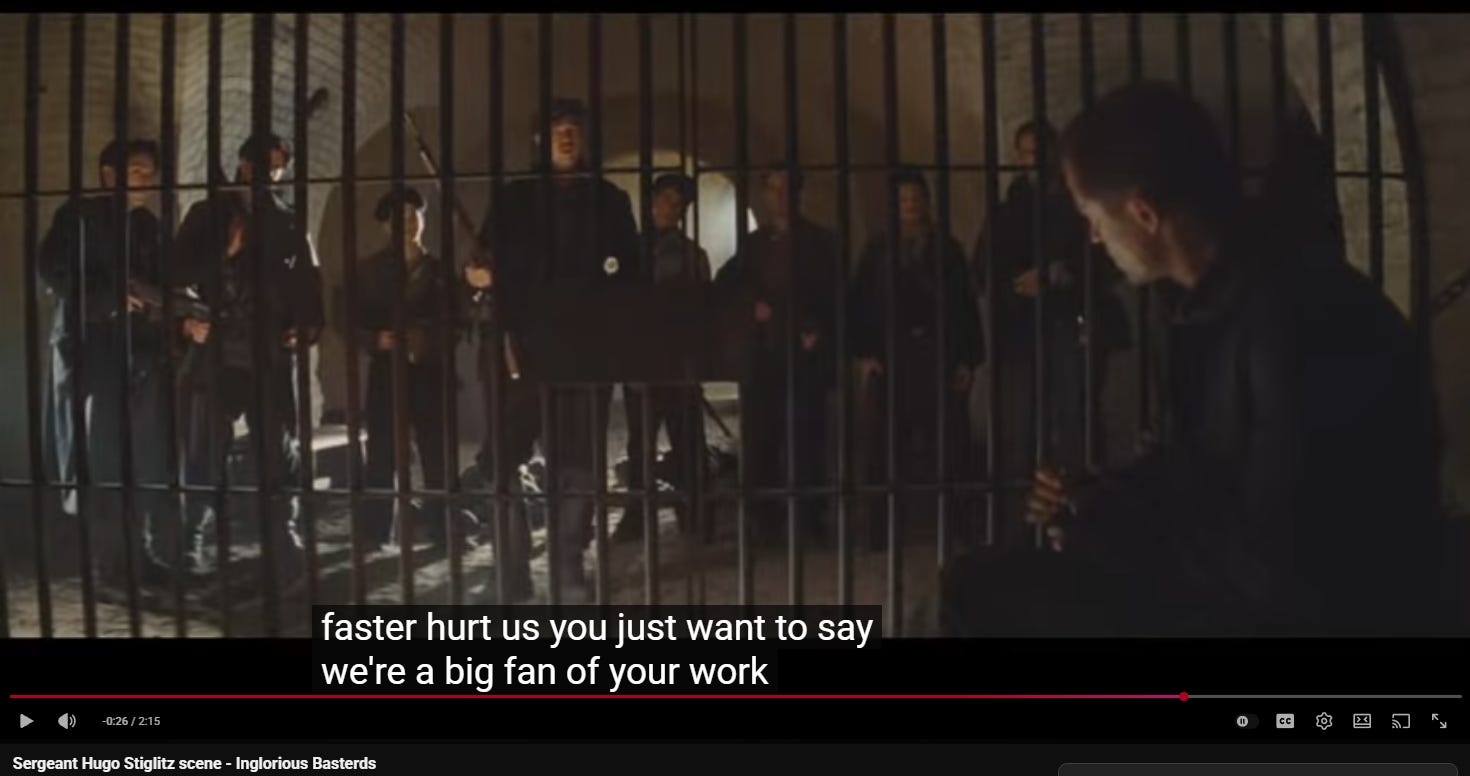
The idea is that breaking nazi-hunters out of prison to help the Allies disrupt the Aryan state that the Third Reich is building would be similar to breaking the child out in Omelas, even if it is not a utopia (the same way Omelas isn’t either). Many people fled or followed orders:
“Those people nowadays who say they would have stood up against the Nazis – I believe they are sincere in meaning that, but believe me, most of them wouldn’t have.” After the rise of the Nazi party, “the whole country was as if under a kind of a spell,” she insists. “I could open myself up to the accusations that I wasn’t interested in politics but the truth is, the idealism of youth might easily have led to you having your neck broken.”
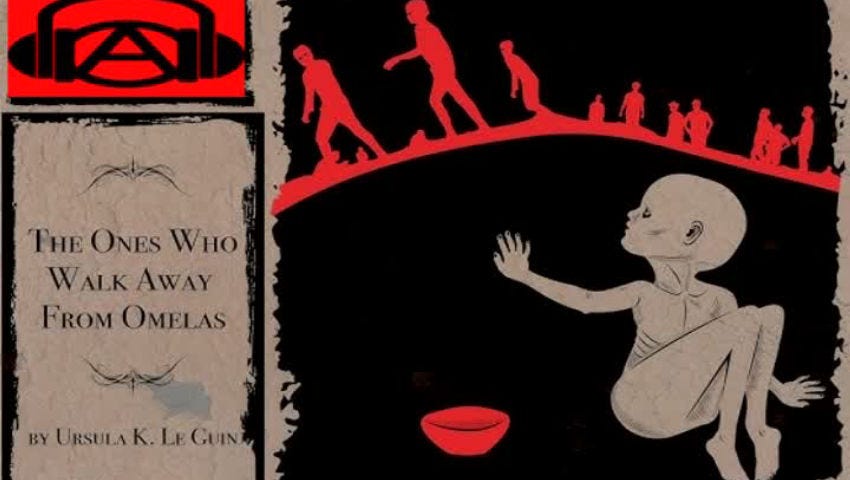
The idea of American GI’s breaking a helpless child out of Omelas’ basement, of course, sounds a bit odd, because it wouldn’t solve the whole utopia thing. Le Guin even suggests that the child, even if free, wouldn’t be ever become healthy again or make a full recovery. I decided not to render a picture what it would look like if the chained child were broken out of prison, so I’ll just use stock footage of the Monuments Men:


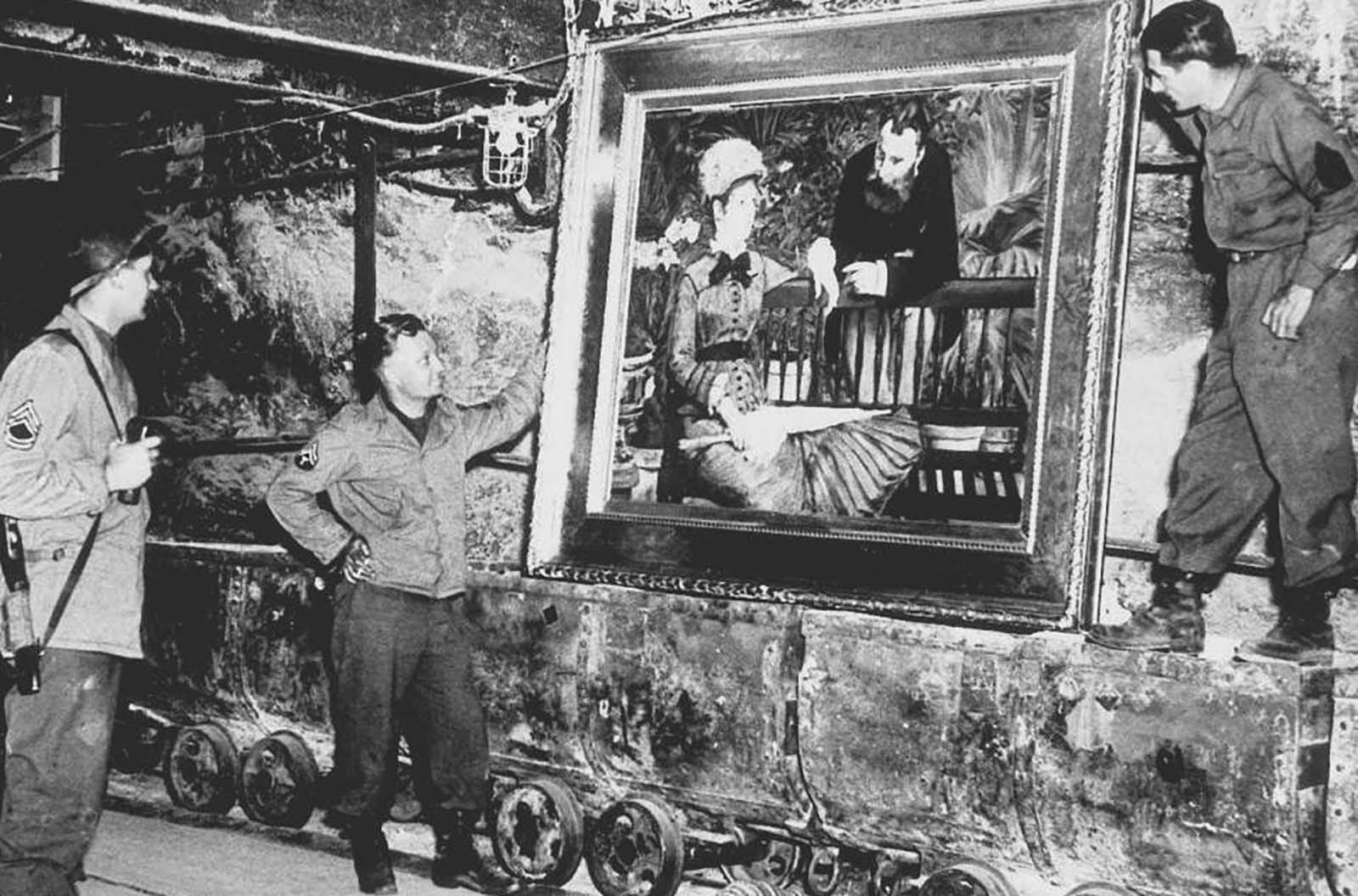
Other cases where new freedoms for an additional person or several hundred thousands of people can mirror real life cases. The Haitian Revolution is probably one example. It might have increased suffering in the short term and even long term, but it certainly was the right thing to do. New research continues to turn up interesting paper trails that detail the quotidan affairs of the clergy.
I am not really sure where to end this article, but I think I covered it all.