

Unflavorfully Efficient
Buried in a January 2007 edition of Science was a brief paragraph on the utility of inefficient moka pots.

It made me question nearly everything about what it means to get published.1
In September 2006, as a first year graduate student at the University at Buffalo (SUNY), I was gifted a complimentary membership to the AAAS (the American Association for the Advancement of Science), which included an annual subscription to Science magazine, which it publishes). By late December, I had already flunked my final exams, and I was told my stipend would not be renewed, nor could I continue the graduate program, despite requesting to stay. I was told that I could withdraw from the program before they officially failed me, as the program advisor(s) stated it would have less of a bad record somehow. I didn’t exactly know what that meant, but I suppose it’s kind of like getting a permanent/long term mark on a credit score for getting a foreclosure on a house instead of proactively settling on a short sale.
When I tried to reapply to graduate school in 2010, I only applied to one school-which denied me, and I started to regret the decision to accept the earlier suggestion in withdrawing. At the time, it seemed like the professional thing to do, but after nearly 20 years, no one invited me back to graduate school, so I wish they failed me instead. Science is about learning after failure anyways. Maybe that was the true test of being a graduate student- showing determination that you really want to stay. Were they bluffing? Probably not- and maybe they were going to fail me anyways. I feel like I completed a self-fulfilling prophecy by accepting the option to withdraw, because in the end, it seems like they didn’t really care that much. Even if I did get a bad record or permanent record showing that I failed my classes, at least it would show that I tried. Now, I still mention it on my resume, but the extremely short duration will sometimes raise questions- I even posted the resume on Craigslist’s “Resumes” section in the late 00’s, and a career coach emailed me out of the blue, suggesting I remove it and the college GPA because it looks bad.
At the time, I moved back to Illinois after my first semester in early January and started my first “real” job (outside of a summer employment at the zoo before college and an internship at a university in 2005) at a temp agency.
A slight consolation was that I continued to receive free Science magazine delivered to my parents’ house, which was a nice souvenir of sorts. I continued to read it of course, because there were a lot of articles in microbiology that were interesting and I understood, having already honed 2 years of upper level classwork in my undergraduate to learn to decipher and analyze. The articles continued to arrive for a few years after the 1st year subscription ended, as promotional quarterly or annual articles, in hopes that I would renew my AAAS membership, which I never did. I once got a call from an AAAS representative from Washington, DC (where AAAS is headquartered), asking me to donate to the AAAS. I told him I wasn’t in a financial position to do so. But I was enlightened and privately amused when he repeatedly called me “Doctor Lostumbo,” apparently not knowing I didn’t pass graduate school, or was saying it out of respect. I didn’t correct him, but I politely ended the call without a donation.
In a way, that call felt like a minor victory. While I didn’t get my PhD, I still got accepted to graduate school, and one person, albeit mistakenly, called me Doctor for the first time. Sure, maybe it’s just a consolation prize, but it felt salient, even if it was ephemeral. While I think I could be a doctor of philosophy, I tend to enjoy being in the thicket of things, too immersed or oblivious to things like “status” or “rank” to really be a leader (or what roles are expected of me to accomplish certain programs). That said, I was suffering from burnout and a brief but destructive dalliance with illegal substances. Had I been slightly more prepared, I am sure I could have completed it in 4 years.
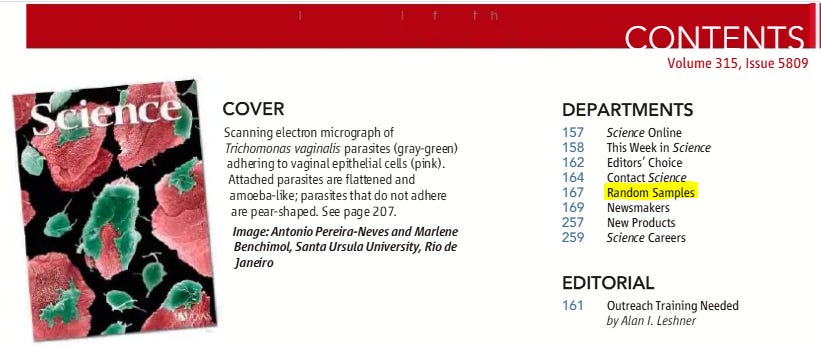
I only wanted to include a brief context of the time that edition of Science magazine was published in addition to what interested me. The rest of this post will/should be about the article and other extrapolations [after re-reading this article before pressing “publish,” I can’t stand by that claim]. Although I don’t remember exactly when I read the article “Deliciously inefficient” on p.167, the title stuck with me for this long, such that I was able to find it with a moderately difficult and iterative Google search “deliciously inefficient Science coffee” (including quotes around the first two words) after more than 19 years. I also kept my print magazines for years, so I might have read that article a year or two later (even if I read the other articles in that edition at the time) and eventually discarded them (though I might have a couple left).
The table of contents did not even include the name of the article, since it was so short, and part of a random curation:
What prompted me to write this retrospective is that a couple days ago, I saw this article on Hacker News (which I occasionally read for its data-lite and text-dense webpage) on elevator efficiencies- how they decide what floors to stop on, when it seems like they are taking forever. The site serves as a discussion forum for a lot of interesting articles in science and technology (less ad-ridden like Slashdot, but with a slightly more egalitarian and visible comment section- comments don’t become invisible or buried if they are downvoted, only marked with a -1, -2, if at all). The link itself was to a website with an educational animation on how elevators work, especially in buildings where multiple elevators operate to serve batches of passengers. Initially, I was impressed with the idea of an educational website that seems to assuage impatient office workers who spend a lot of unneeded intellectual capital each morning and afternoon wondering why their elevator is taking so long, and possibly, what they can do to improve it. But then I became skeptical about the source of funding. If it was privately funded research, great. If it was publically funded, fine, but I hope they didn’t spend a ton on it.
The site concludes, “This article just scratches the surface of elevator algorithms. Next time you’re stuck waiting for an elevator, try not to take it personally. The elevator did hear you, it just has a lot to think about.”
I already assumed elevator efficiencies were solved, and most likely the delay is due to accommodating batches of passengers on a certain floor over selectively making a single floor wait longer, but I now realize there are many different types of elevators, and most have a system that someone determined to work the best for the estimated volume of passengers. Thus even if I am waiting a little longer than I expect, I know an elevator isn’t typically malfunctioning when it seems delayed. Kind of like going to the DMV. A lot of people like to criticize the DMV for long wait times, but in the U.S. at least, DMVs are actually reasonably efficient, if one factors in that Americans are virtually entitled to spend as long as they need to sort out their license issues, and any long line or wait isn’t a bug, but a feature of democracy. In a worse system or government, people might spend less time in line but more time making repeated trips because something doesn’t get processed correctly. Plus, unlike other countries, it’s a lot harder in the U.S. to permanently get one’s license revoked.

I drink coffee and tea, but mainly coffee. Thus while I don’t currently spend part of my day going up and down elevators, I do spend a bit of time brewing Italian espresso (I also make American and French press occasionally). Since an early age, my family has always used a moka pot. These cost around $30 for a 3 cup by an Italian brand like Bialetti, and $40-$45 for a six cup They used to cost a little less before inflation. Even though my parents could later afford an expensive coffee maker, they still choose to use this lowly moka pot. And I realize there are some qualititative differences between various types of coffee pots- the Napolitano espresso maker, which my grandmother used, the industrious Saeco Aroma, a 15 bar (PSI) espresso maker that my brother gifted me 10 years ago (a hand me down, but still a a nice addition to my 1.5 Bar moka pot), and of course, the instant drip brew machine, which I appreciate for its capacity but also accessibility.
There are countless other brewing machines and coffee extractors, all with some variance that appeals to aesthetics or flavoring methodology, some that have measurable differences in flavor or caffeine extraction, but all offering some tradeoff in both subjective and objective terms. Despite spending years testing different machines, it’s never clear which machines are better, and it’s probably by design. While certain types of ground coffee brews better in the instant drip, the finely ground espresso beans work better in the moka pots and espresso machines. But one thing I haven’t been able to determine was whether a 15 bar machine is “better” than a vapor brewed moka pot. In the former, coffee is placed in a chamber subject to heated water pushed through it, delivering a strong and flavored cup, often just 1-2oz.
In a 3 cup moka pot, the same amount of coffee is placed in the chamber, but more water is boiled, creating a vapor pressure that slowly pushes the boiling water up into the top chamber. My parents always instructed me to adjust the stove temperature to simmer or low when the water starts to boil, because the water needs to flavor the coffee, and boiling it quickly at maximum speed will not only create rapid splashing of boiling water around the stove, but it will not absorb the coffee flavor. Obviously one will learn that after the first time, or at least try to avoid it and not be absent minded and leave the room so as not to forget the coffee is boiling. If one is patient enough, they can also boil the water on the lowest setting, which takes a little longer but can prevent that rapid boil if one happens to be lazy and not actively adjusting the moka pot.
The more water one adds to an espresso machine like Saeco, the more watery it will be after all the flavor is extracted. In fact, one rarely needs to add much water. This can produce a desirable strong flavor, but also leading one to think they didn’t get all the coffee out. But realistically, there isn’t much more coffee- neither flavor nor caffeine. It’s as if the unflavorful parts are left in the coffee chamber. Nearly all of the coffee making is done with hot, nearly boiling water. A steamer rod is available if one wants to make capuccino or a mocaccino.
With a moka pot, there isn’t a lot of pressure going through the coffee chamber- only 1.5 Bar. But what it doesn’t extract with hot water movement, it makes up in time. Maybe not 100% of the strength as a 15 or 20 Bar espresso machine, but supplemented with coffee vapor that fills the room with a nice coffee smell. This aroma is stronger and more immersive than the efficient 15 Bar. While I used the Saeco espresso maker for around 10 years, eventually I needed to clean the water pump tubes (which can grow biofilm) and finding a replacement, plus installing it was not simple. So a couple years ago I switched to a Gourmia brand (made in China), and it was around $50 at the time: These are far cheaper than some of the higher end 15-20 Bar machines, but it provided a similar level of strength and, more importantly, clean water pumps. It’s also much lighter than my Saeco machine, though that improvement requires me to hold the machine clockwise when I rotate the coffee chamber handle counter-clockwise to fasten it, because the machine rotates it with it. It’s not like suction feet would do much to help that, and it’s not something that should be drilled to the countertop. I also bought a 4 cup moka pot, this time with induction, as I was interested in the efficiency of heating, even if I don’t always want a machine to efficiently run water through a 15 bar espresso maker. The comparisons I used in this post are between the two- the second is a brand called JingleChoo (often these seem like randomly generated company brands for the purpose of selling on Amazon, or AliExpress or elsewhere).
The Science article references an American Journal of Physics paper, where real equations, such as Darcy’s Law were used to calculate the efficiency. The paper cites several references, including an animation of the boiling process (long archived by the Wayback machine).
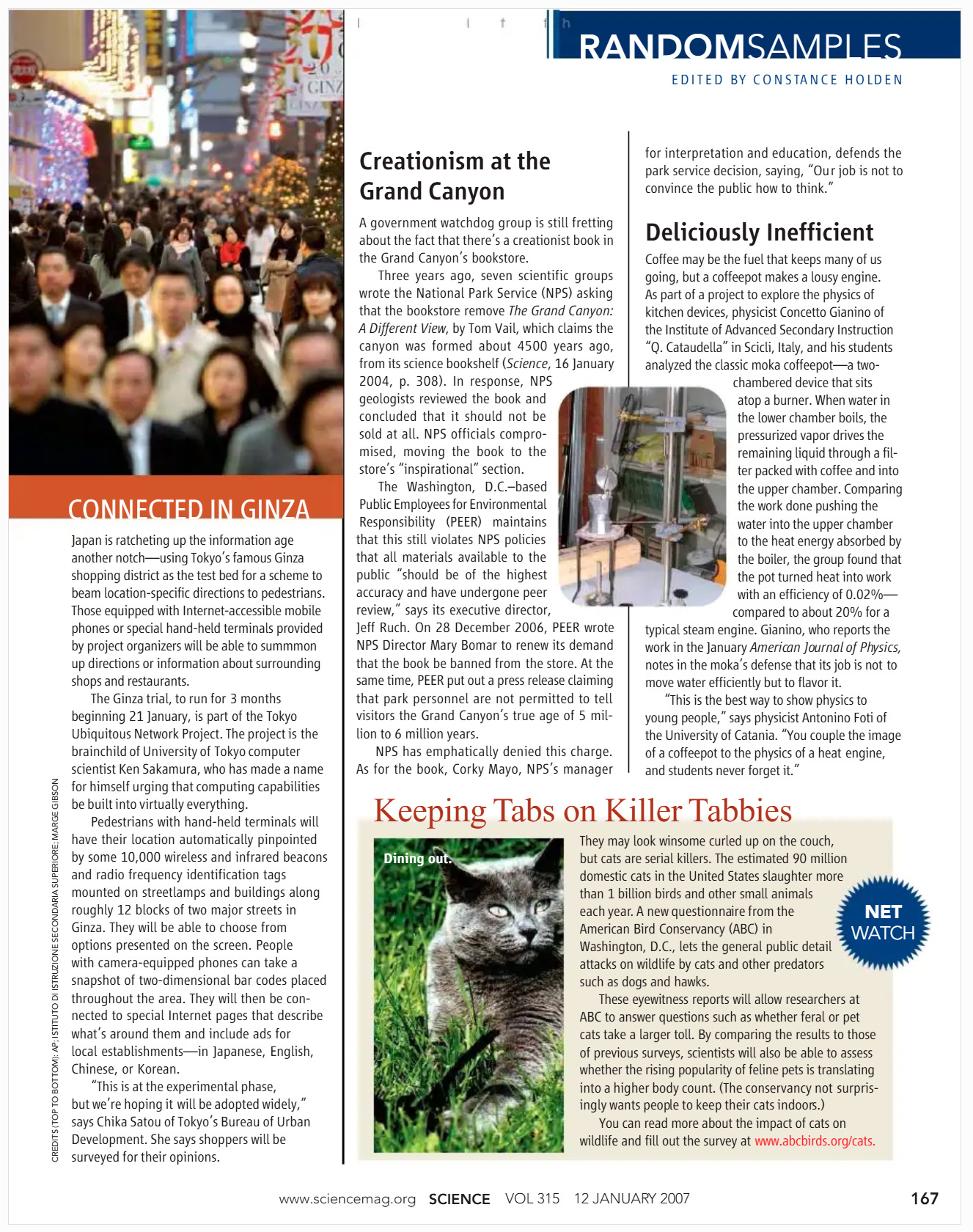
What’s interesting is that the moka pot process is defined not in terms of the speed of moving water efficiently, but flavoring it with coffee. In other words it is efficiently flavoring water with coffee, as a measure of time. Perhaps this is one of those instances where experts and the public are separated by a gap of understanding, because the word efficiency can be misused for political purposes far beyond their original intent. When people say solar panels are only 10-15% efficient, I like to repeat a trope I heard during the Iraq War. “America needs to wean itself off foreign oil” Won’t you wean yourself off foreign oil? Won’t someone think of the domestic energy possibilities?


Being able to afford inefficiency is like being able to afford independence and sovereignty. I remember reading a LinkedIn post a few months ago, maybe a year ago, where someone asked why calculators with physical keys aren’t manufactured as often as they once were. An engineer gave an explanation that it’s far economical to rely on software for that, as so many smartphone apps have done. Even software eats software, merging multiple functions into one program, ceding control to a system manager. It may be a harsh economic truth, but something is lost by the average user when functions are abstracted away in being able to understand how something works: comprehension.
“Fantastic. Now tell me what the medication is designed to do? What is
Dylar? What are the chemical components?”
“I don’t know,” she said.
“Of course you know. You’re brilliant. Everyone says so.”
“What else can they say? I do neurochemistry. No one knows what that
is.”
“Other scientists have some idea. They must. And they say you’re
brilliant.”
“We’re all brilliant. Isn’t that the understanding around here? You call
me brilliant, I call you brilliant. It’s a form of communal ego.”
“No one calls me brilliant. They call me shrewd. They say I latched on
to something big. I filled an opening no one knew existed.”
“There are openings for brilliance too. It’s my turn, that’s all. Besides,
I’m built funny and walk funny. If they couldn’t call me brilliant, they
would be forced to say cruel things about me. How awful for everyone.”
-White Noise (1985), Ch. 25, p. 295
Fewer people know how an engine works because few cars today have a manual transmission. There is less “stick” in the loop where the shift in gear would dynamically interact with the driver’s hand. Even on a calculator that uses an integrated circuit such as the 4004, a button is designated for a single function, whereas an onscreen touchscreen keyboard is programmable for any function, assuming the user has access to that programming guide. A user manual may at least describe what the functions on a keypad are for. It brought a smile to my eyes when I read a few months ago that automakers are reintroducing basic knobs back into cars, because people want no nonsense functionality when driving a car. Just like in aviation, cars need to have knobs in predictable places to avoid cognitive overload.
Getting back on topic. A small part of my day is spent wondering whether I’ve brewed coffee in the best most efficient most flavorful/caffeinated way possible, because every time there is a little variance in the amount of coffee used (not packing the chamber too much every time), the amount of water used, and the type of beans. Sometimes a vacuum packed brick of espresso will taste bitter or rancid, whereas other times it will be much fresher. I have purchased whole beans on occasion, and have a coffee grinder too. I prefer to wear ear protection, because the loud, high pitched whirring noise. When you have 50% of your hearing left, this is crucial.
While it’s true a lot of people spend a lot of money on coffee, I can’t see myself ever indulging in any other type of stimulants, including Red Bull or Monster energy drinks. Something about these drinks have way too much caffeine, and my limit is usually 2 cups a day- one in the morning, and one in the afternoon. Not only is there a qualitative difference in the type of coffee brewing, but more stimulants does not automatically translate into productivity, although I realize Erdos took them. Many people have experienced the caffeine crash, and a caffeine withdrawal, or worse. and as bad as it is, is far less nauseating than a cigarette withdrawal, which is why I haven’t smoke a cigarette in nearly 20 years. So any “down-time” I have by spending my summer doing nothing, or idling and thinking an idea will arrive, is not something I really regret. I often ask myself if I am being productive enough, and the phrase “work smarter, not harder” has at minimum, a kernel of truth to it. The amount of satisfaction I have with a job depends a lot on whether I can spend enough time reviewing whether I am spending enough time on the present and future goals.
In 2007 and 2008, I was happy to find temp work. Now I rarely consider it. While I believe it could be practical in cases where I am traveling, I still don’t think it’s ideal. But what is ideal nowadays? Even if permanent positions are more stable, Everything is so personalized, so a lot of my expectations about careers and relationships have gone out the window. I’ve never had this super strong idea where I wanted a picket fence and be married to a “trad wife” (which, for a fact, were never called that in the 50s, just “wife”), although I have always been open to it. What I got in pursuing that too eagerly was two failed engagements. So I’ll leave it at that for now.
I prefer not talking about my personal life here, mainly because there aren’t many “success” stories to write about (if that’s even a proper definition or rationale for writing about one), and to respect other people’s privacy.
Of course, a lot of people would like to have “a couple kids, American dream. You’d never suspect them. She’s pretty, he’s lucky.”

In the 2002 movie Adaptation, Susan Orleans (Meryl Streep) is at a dinner party with her urban friends and they joke about the Orchid Thief, the subject of her New Yorker story that she’s writing about. She retreats to the bathroom and in a voiceover narration, she says, “I wanted to want something as much as people wanted these plants, but it isn’t part of my constitution. I suppose I do have one unembarassed passion. I want to know what it feels to care about something so passionately.”
[Spoiler alert: towards the end of the movie, Orleans and Laroche have a conversation in a motel or bedroom, where he discusses his future ideas for work, and she becomes disappointed or disillusioned in the realization that neither he has a strong passion for orchid plants.]
And that is why I don’t feel strongly anymore about graduate school.
Concluding notes
One of the surprising things I discovered when I was about to wrap up this article in my search for the calculator post on LinkedIn was that I read Intel recently announced it is licensing its crown jewels x86 RTL to a partner for the first time in 10 years. It is a bit of a shock because it’s so rare that they’ve done that, and its proof that either their new CEO is willing to take some chances or they’re just desperate for money and foolish because why would else would they want to license x86 (no I get it, it’s nice to have that exclusive rizz).
Future articles
I’ve often wondered whether the chained child in Ursula Le Guin’s 1973 short story “The Ones Who Walk Away from Omelas” was an allegory for Jesus. Maybe I heard it on a podcast or the internet a few years ago, but the idea was interesting, even if it’s not very congruent. For example, sometimes I wonder about monks who self-immolate in protest of some injustice. Like, if a monk wanted to claim they would offer to trade their life for the freedom of all of Tibet, a government might be indifferent to that. The historical version of Christ offering himself for an unlimited salvation today sounds like a prohibitively expensive exchange. When hundreds of prisoners are traded for a single or few hostages, or when the “merchant of death” is traded for a WNBA basketball player of a far lesser crime, I don’t understand politics. Or maybe I do, and I’m being coy and naive at the same time.
Notes on the Title
“Unflavorfully efficient” refers to the opposite of the Random Samples title in the Science magazine. It could refer to anything made gaudier, ersatz, being given a cubicle instead of a private office, or simply watered down. But in this case, water isn’t a moka pot’s sole output, and flavoring time is incomparable to the speed of water flowing through a pipe. My title isn’t suggesting that moka pots aren’t flavorful- they certainly are! But I didn’t want to copy Science’s headline, and wanted to explore what the opposite also means.
In high school, I took Italian for my foreign language elective. While I did speak at home, I didn’t know how to read and write Italian before I took that class. Our teacher showed us the 1965 film “The Agony and the Ecstasy” which depicted the conflicts of Michaelango and Pope Julius II while the church awaited his completion of the painting of the Sistine Chapel. My favorite line in the movie was when the pope would ask, “when will you make it end?” and Michelangelo says, “When I am finished.”
While the coffee I purchase might not be Sistine Chapel grade water-based pigments, I like to think that if my diminutive moka pot needs a little more time on simmer to flavor my coffee, it should be able to toot “when I am finished!!” in steam whistle speak.
And if solar panels need a little more time to generate a few watts of power to use my induction cooktop via an inverter compared to a gasoline or coal-powered generator, so be it.
And if solar calculators need a little more time and light to calculate pi to the 8th digit on a four function calculator, so be it.2
Basic research is never about efficiency. Yet there was a liberating aspect in reading that Science article, because it didn’t seem to be about the “natural world”, until you realize that physics covers the entire world. One can get published in Science even when covering household or culinary products, and it’s still considered science. Initially, when I started to research that article 3 days ago, I had forgotten the context of the research. I remembered it was titled “Deliciously Inefficient” (coined by the editor, Constance Holden, who died in a bike accident in 2010), but I forgot who published the research paper and whether it was for a university or somewhere else. After discovering that it was for a high school physics class, I softened my scrutiny, as I assumed prior to that it was another expensive university research project that would have made its way into the Congressional Waste Book report that taxpayers have spent money on since 2010. Different country, different school level, and yet after 20 years I started to mistake the context and make assumptions. Admittedly, I didn’t question nearly everything about publishing. Though I should have. And much earlier.
An AMD FX8320E PC connected to a utility grid-supplied power source was used to type this article. Thus I have benefited from the computational advances of a system that processes 34,557 MOps/Sec (Thirty Fourty Thousand Five Hundred Fifty Seven Millions of operations per second). I have had an interest in powering my home with solar panels since 2009, but have encountered many hurdles in doing so.