
Whimsical Maps: Part 2
I bring the actual maps

I’ve been away from writing Substack articles for more than 2 months because I’ve been moderately successful at enjoying my summer, or at least spending more time off Substack. It isn’t because I haven’t wanted to write a Part 2 to my early May post, which seems like eons ago, but because I haven’t figured out how to wrap up a few ideas. If I could at least write an article that covers both old and new business, I reasoned it might be worth reading, since it feels a bit overdue (and only because I sort of promised).
In my previous post, I briefly mentioned “Whimsical Maps,” and at the time it was more concept and cop-out because I didn’t end up writing thoroughly about it. I mentioned it because I had the idea in my head for a few weeks, but also months, if not years, on how I could share a joke, and since I haven’t done standup comedy in a decade, realize the internet is an unpredictable medium for delivery. It’s often hit or miss- moreso the latter, unless you’re already popular (laugh tracks make things sound funnier, even in Mr. Robot). But anyways, I had this totally unrealistic idea based on a Seinfeld episode. The one where George joins a book club and needs to read Breakfast at Tiffany’s, but, not wanting to do his homework, opts to rent the movie, only to find out it’s been checked out. George manages to peek over the counter to find the address, ring the bell of the stranger who is renting it, and even be allowed to watch it at their apartment. Then in typical Seinfeld absurdist fashion, Costanza not only wants to watch the movie, but asks for popcorn and expects the residents guests to shush so he can hear the movie.
This is, of course a five sigma-level event of unlikelihood, but it happens quite frequently in the world of make-believe. Anyways, my mind wanders at times and sometimes think of similar unrealistic scenarios, for self-amusement, I suppose? In my trip to Italy, I have long wanted to visit Venice and the fictional library where Indiana Jones searched for the hidden passage, so that part is true, and what better way to illustrate one’s destinations with a “wish list” map that offers few similarities of theme or activity in different countries? Also, a mnemonic-like way of remembering European countries, the same way many Americans think Wisconsin is known for its cheese. But then when I started filling the map, most of the countries were either national mottos or commodities that they were known for, rather than destinations I necessarily wanted to see. And I ended up with this:
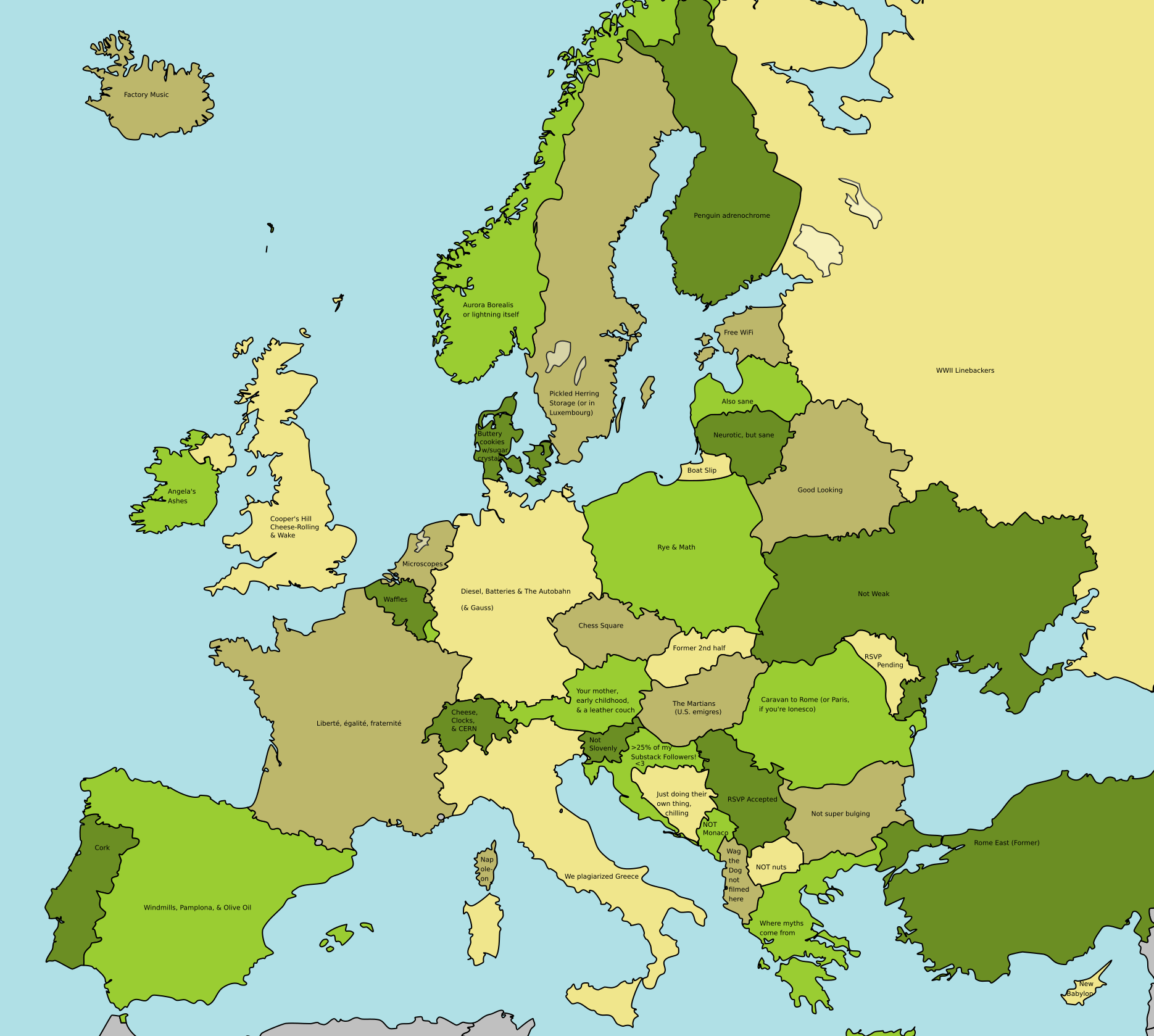
Note: The image was converted from SVG (Scalable Vector Graphic to PNG, so it is hard to read the text, even when expanding the image in a new window. So I have retained a copy of the original file, which can scale the text larger with clear and zoomable lines in this downloadable SVG file link: Google Drive. Your phone probably(?) has an SVG viewer.
I don’t know why I wanted to share it, but maybe it’s better to share my worldview, rather than have to explain it in a long paragraph which often feels futile and overly academic, if not pompous. A picture is worth a thousand words, so perhaps that was a shortcut.
And before I begin the new business, I want to cover my bases on how I envisioned my Italian Breakfast at Tiffany’s sketch adapted from the Seinfeld TV episode. It requires whimsical logic, a sort of esoteric kind of nonsensical way of thinking. For example, “Kazakhstan” Borat travels to the U.S. Borat wants to meet Pamela Anderson. Borat “meets” Pamela Anderson (although it was staged). An American Borat does not know Pamela Anderson. But American Borat wants to travel to Italy instead. American Borat Wants to meet Giorgia Meloni. American Borat wonders if Italians still rent VHS or DVDs, and hopes Meloni enjoys movies other than Lord of the Rings, and prefers physical media over Netflix or digital streaming. American Borat finds the last remaining video store in Rome, and the rental store miraculously has Breakfast at Tiffany’s, which Meloni happens to have checked out. American Borat sees the clerk is distracted by another customer, so peeks over the counter to find if the President of the Italian Republic’s apartment address is listed. American Borat takes a taxi, which drops him off at the entrance of the official palace (which is not an apartment) and asks the security gate booth guard if he can watch Breakfast at Tiffany’s with her. That’s about as plausible as an actual Kazakhstani meeting Pamela Anderson. Hopefully, this story raises more questions than it answers. That’s sort of the point.
Often times people mistake parody for conflation. For example, On January 20th, 2017, the Twitter account for the POTUS changed from Obama to Trump, and I was curious what photo he would use after the inauguration:

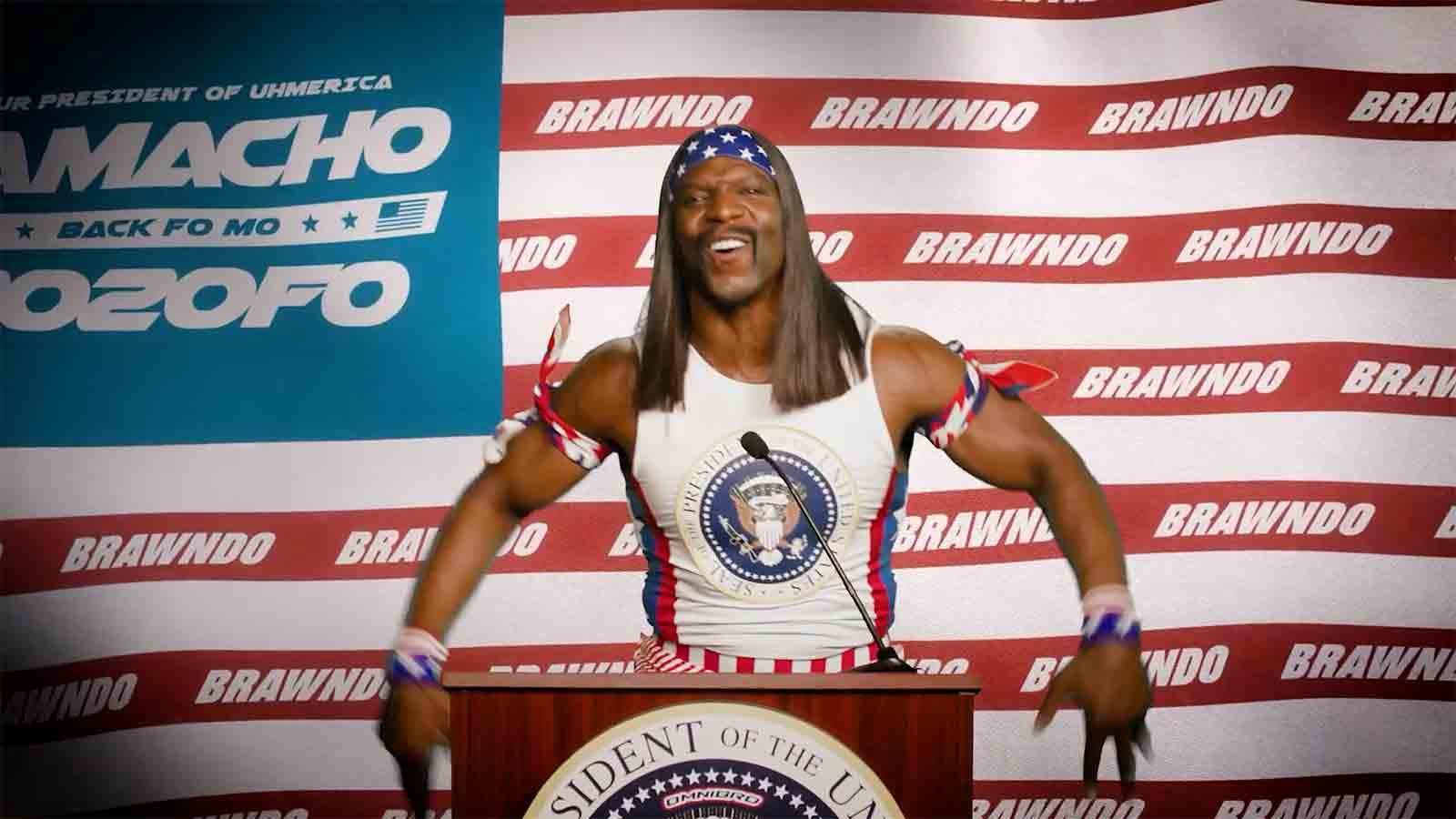
As soon as I saw it that day, I immediately thought that it looked like President Camacho. To be sure I wasn’t just speaking nonsense, I ran the question to my trusted friend in email, to bounce thoughts on the idea. The response was “haha:”
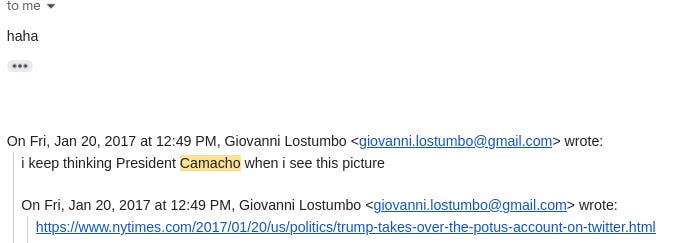
I felt vindicated, because some people would never make the connection, especially if they only look at physical attributes. What I was seeing was the charisma, or even just a smirk, RADIATING from each of them, as if only some people have “charisma vision.” Not in a million years would someone without this extra perception be able to notice the similarities. Of course, it wasn’t the first time someone made that observation.
Which brings me back to the Seinfeld episode. Does Giorgia Meloni share much in common with a New Yorker? The regional American accent is closest to Italian, even if that’s still a broad categorization. It also took me a while to write this post to convince myself that I don’t have to be infatuated with someone to make a joke pretending I am, and that some people might get that.
Onto new business. As I mentioned in earlier posts this year, I took a break from employment in mid-November using my savings to attempt to explore a new position, study, and to travel. In a lot of ways it feels like failure, because at 42 years I still haven’t found a calling, if I am supposed to find one. In the past, I’ve been pretty content with finding new work, even if it is semi-permanent, and learning new things- my first job out of college (with the exception of a graduate school semester stipend) was a temp agency. But I still feel it’s right to listen to my body, and not my brain, when it feels like it needs a rest. Even if I don’t feel overworked, it’s as if my body sends radio waves across a galaxy, requiring a long and silent meditation for my brain to hear it clearly without noise.
I watched a few movies over the past year. I recall sometime last summer, I stumbled upon this 1995 indie flick called “Don’s Plum,” filmed in a Dogme 95/Jim Jarmusch/Clerks like shot, and was uploaded to YouTube in 2024.
The director, Dale Wheatley, who calls himself a “blacklisted filmmaker,” has a weekly video podcast called “Too Real Live.” I had been watching a few of their podcasts over the course of several months, and I really feel engaged with the discussion. I am not too much of a gossiper, but it’s interesting that they covered the minute details of the Justin Baldoni and Blake Lively Case. Like, there’s a lot about Hollywood that I still don’t know. Or maybe it’s because I found the Johnny Depp and Amber Heard Case supporting testimony so funny:
They also shared non Hollywood stories that piqued my interest, like a story on Whooping cranes raised by Sandhill cranes:
The podcasters compare it to the plot of the 1979 film “The Jerk,” where in the intro, Steve Martin believes his own identity to be “I was raised a poor black boy”, and I also commented on the similarity around the same time. Coincidentally, I actually wrote an adaption/outline/fan fiction of that film in 2015, but I set it in China. It’s a terrible short story- so bad I didn’t even use my real name to publish it. Don’t buy it unless you’re certain you never want to see $2.99 again. In fact, forget I ever mentioned it.
I don’t have many “favorite” Youtube channels, but occasionally I enjoy watching Adam Savage’s “Tested” because it speaks to so much to my DIY ethos. I had heard of “Mythbusters” for years, but didn’t really watch many of the shows. I recall the first time I found Adam Savage interesting was a 2009 talk he gave at DEFCON 17 in Las Vegas.
The Youtube quality is poor (average for 2013), but it’s only 25 minutes, if you exclude the Q&A, and I watched it it maybe 10 years ago? I don’t really remember. I found it so authentic, and wondered a little why others can’t be like him. In a way, it kind of shatters the myth that celebrities need to be fake to succeed. Of course many actors know when to be real off stage too. While he has worked in the entertainment business for decades, it’s always been as a stage hand/set design rather than in an acting role, which was his early career interest. Yet his ability as a presenter/educator is phenomenal. I once wanted to be a science educator, not so much like Bill Nye, but more on an abstract plane, or bus...like a cartoon avatar - a.l.a. Miss Frizzle- Or “Mr. Frizzle”.
In my improv years, I envisioned a show involving some mad scientist character, mixing my interest in education and theatre. But that too fizzled out.. Which probably is why I liked watching Adam Savage’s keynote on failure. An interesting topic, since it sounded so taboo...
In recent years I’ve thought of roles like “product manager”, “systems architect”, and “CTO”, but I would be kidding myself- I have ideas about product design and research, but I’m not really the kind that can attract a large team. I was pleasantly surprised that Savage recently addressed this very issue on his Letters to the Editor for a person who inquired about roles where they are subservient to a manager, and are not the art director that they want to be (i.e. they are a “big thinker”).
Part of my problem is that I’ve found jobs where I’ve wanted to contribute more than just task completion but feedback on process improvements. Sometimes the advice gets heard. There is a great Substack that covers more on that.
That said, I try to pick employment positions where I am increasingly conscious of my job roles and expectations, both for the sake of not trying to be the architect when I realistically can’t make those decisions or have those capabilities nor experience. Unless I am interested in starting my own company, which I have no plans for, being a product manager seems an impossible fit.
What I admired about his DEFCON speech was how perceptive he was about bullshitters. 10 minutes into the video, he recounts a story about building a window display to a co-worker at Industrial Light & Magic, who says, “Man, I’ve never screwed up a job that bad.” And he says, “Really?” The talk is about failure, but among the people who learn from it, the best are those tend to really take its lessons to heart rather than pretending they never failed deeply.
And this past week I was thinking about that Too Real Live podcast, wondering what led to this indie film director to being blacklisted. Was the director unwilling to compromise artistic integrity for a commercial production? Is he like Adam Savage, no longer with a cable channel, but one who would rather steer his own artistic license on YouTube than see it watered down by a major TV studio? My guess is “probably yes.” Even though I haven’t achieved nearly anywhere the success of the filmmaker or educator, I hold a similar viewpoint, perhaps at the risk of increasing precariousness. I am well aware I can’t live on my savings forever, and short of a business plan, will need to search for a position soon. While I didn’t need to write a blog to make this fact official (again), I’ve felt my summer needed an intermission, and July 15th happens to be just about mid (in time elapsed, not quality).
The saying “If I can do this, so can you” may be a logical fallacy when comparing myself to people who have the right ideas and the right attitude, but I seek to emulate people who manage to retain their integrity, because I’m convinced after reaching out to many people, not many of the ones I reached out to are.
For weeks, I’ve wanted to write a Substack about how “some people persons suck.” But that would be too crude. Yet it’s true. Some people persons really do suck. And they don’t build vacuums for a living, but if they did, they would get an exemption, because their job is to build products that practically suck. Except some do it voluntarily, for completely different reasons.